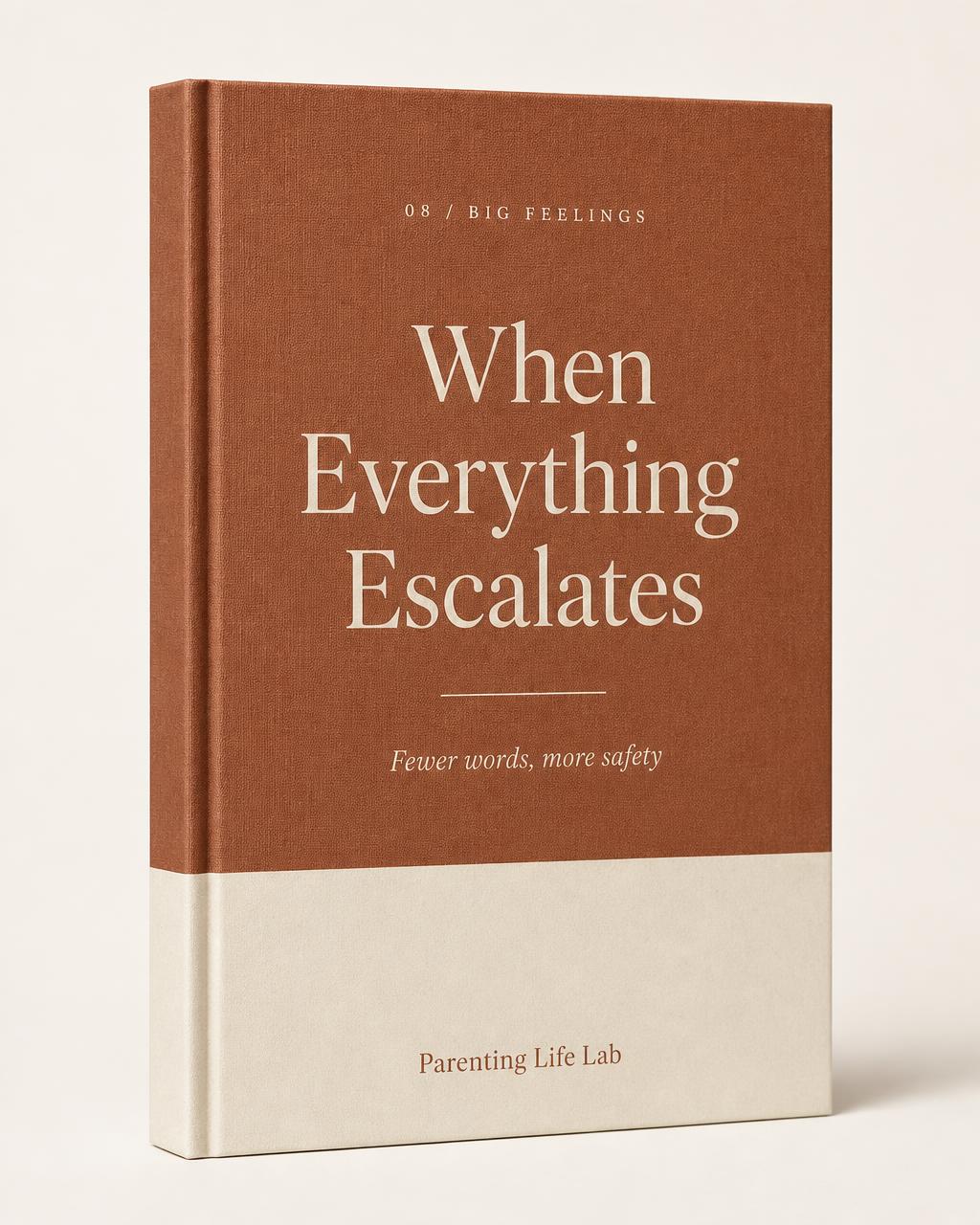
When Everything Escalates
Different topic every time. Same shouting, same shutdown, same evening ruined.
Fewer words. More safety. Better repair.
Instant PDF download · Secure checkout · Keep it forever
- 103 pages
- Instant download
- Written by K P S Moeller
- Personal support
One evening of reading and writing, and you finish with your own plan on paper — not another article to remember.
Free advice tells you to stay calm. This gives you your own escalation map, safety decisions made in advance and a repair routine, written down before the next peak.
Map one recent escalation and write your two earliest signals plus your safety decisions. That alone changes the next bad morning, and you never have to finish all 103 pages.
Taking more than one? Any 2 guides save 15 percent, and the full library saves 25.
Sold by LouLouEntertainment, Stockholm. Payment handled by Stripe, download delivered instantly and emailed to you. Questions answered personally at hello@parentinglifelab.com.
When you finish the Core pass, you'll have this written down
- Your escalation map for this family, from first signal to peak
- The early signs you have been missing, written down
- A fewer-words script for the climb
- A recovery and repair routine for afterwards
- Your 7-day plan, including your own escalation triggers
How it is used
- 1Core60–90 minutesRead it in one evening and fill in your own plan as you go.
- 27-day testOne weekRun the plan for a week. One small change per day, nothing rebuilt overnight.
- 3Deep DiveWhen it breaksCome back to the section for the situation that went wrong, and adjust.
103 pages in total, Core first and Deep Dive after.
The mechanism, step by step
01Map the climb
You plot your household worst moments from first signal to peak to recovery, on paper.
02Find the early signals
You write down what is visible thirty seconds before it becomes unmanageable, for the child and for you.
03Decide safety in advance
Hitting, throwing, running, doors: the decisions get made now, not during the peak.
04Use fewer words
A short script for the climb, so explaining stops once problem-solving has already stopped.
05Track for 7 days
A week of recording climbs rather than trying to prevent them, which is what reveals the pattern.
06Repair accurately
A recovery routine that closes the moment without asking the child to manage your guilt.
If the other adult is not ready, start alone. The workbook has a section on doing this without turning it into a second conflict between adults.
If you only have 20 minutes
Map one recent escalation and write your two earliest signals plus your safety decisions. That alone changes the next bad morning, and you never have to finish all 103 pages.
It is never about the shoes. But the shoes are what is happening at 07:52 when a child is on the floor, you are already late, and something in your own chest has started climbing too.
Children and adults can be furious, disappointed and overwhelmed without the family failing. The challenge is when intensity rises so fast that safety, dignity and any chance of solving the problem disappear.
This workbook owns the process rather than the topic. Screens, homework, bedtime, siblings, leaving the house: the escalation is the same shape every time.
This is not a behaviour program
There are no consequence ladders here and no scripts for winning the moment. During a real escalation, nobody is learning anything, including the adult.
What changes outcomes is earlier recognition, fewer words at the peak, safer actions, and repair that is accurate rather than performative.
If your conflict stays inside one domain and never loses safety, start with the domain guide instead. This one is for the pattern that repeats across all of them.
What is inside the workbook
10 short parts across Core and Deep Dive, written to be used rather than read once.
- 01
Your escalation map
The shape of your household worst moments, plotted from first signal to recovery.
- 02
Recognising the climb
The early signals that are visible thirty seconds before it becomes unmanageable, for the child and for you.
- 03
Fewer words
Why adults keep explaining after problem-solving has stopped, and what to do with the impulse instead.
- 04
Safety at the peak
Concrete decisions about hitting, throwing, running and doors, made in advance rather than in the moment.
- 05
Your own escalation
The honest section about adult tone, threats and the things you regret saying, without shame as the method.
- 06
Recovery
What the twenty minutes after a peak need to contain, and what to keep out of them.
- 07
Accurate repair
Repairing with a child in a way that does not require them to manage your guilt.
- 08
When one adult is not ready
Starting this alone, without turning it into a second conflict between adults.
- 09
Patterns by topic
How the same escalation shows up around screens, school, bedtime, siblings and leaving.
- 10
The 7-day plan
A week of tracking climbs rather than trying to prevent them, and what that data reveals.
A look inside
3 of 103 pages shown at full size. Nothing here is a mock-up — these are the pages you print.
This is for you if
- Different topics end in the same shouting or shutdown pattern
- A child becomes unsafe when overwhelmed and you need a plan, not a theory
- You lose control of your own tone more often than you want to admit
- You need something for safety, pause, recovery and repair in one place
Probably not for you if
- Your conflict is limited to one topic and never loses safety. Start with that domain guide instead.
- You want a discipline system with consequences and rewards
- There is ongoing violence or fear in the home. That needs professional and local support.
What this is built on
This workbook is not original research. It is a practical translation of work by people who did the research, tested against one ordinary family over several months. Here is what was read while writing it, and what each book actually contributed.
The Explosive Child — Ross W. Greene
Handling the moment and teaching the lesson are separate jobs. Trying to do both at once is what makes escalation worse.
No-Drama Discipline — Daniel J. Siegel & Tina Payne Bryson
Connect before redirect, and why fewer words work better than more when a child is overwhelmed.
Beyond Behaviors — Mona Delahooke
Reading escalation as a nervous-system state rather than a choice, which changes what you do first.
Book links go to Amazon and may earn a small commission at no cost to you. The full reading list behind the site is on the sources page, and the writing process is described in the methodology.
Edition 1.0 · updated August 1, 2026
- v1.0 (August 1, 2026) — First public edition. Every future revision will be listed here with the date.
Buy once and every later edition of this workbook is yours. Updates are sent to the email address you ordered with.
Questions people ask before buying
- What exactly do I get?
- A 103-page interactive PDF workbook, formatted for US Letter. Core is the first pass, Deep Dive is the troubleshooting library. Print it or fill it in digitally in any PDF reader that supports annotation.
- How is it delivered?
- Instantly. After checkout you land on a download page, and the same link is emailed to you so you can come back to it later.
- How long does it take?
- Core takes about 60 to 90 minutes, followed by a 7-day test in normal family life. Deep Dive is meant to be read in pieces, when a specific situation comes up.
- Can I get a refund?
- It is a digital file, so it cannot be returned once downloaded. If it is not what you expected, write to hello@parentinglifelab.com within 14 days and we will sort it out.
- Do I need to buy the other guides too?
- When Everything Escalates is complete on its own. The guides share a language, so they stack well, which is why two or more come with a discount — and until 31 August the 15% welcome offer stacks on top. None of them assume you own another one.
- Is there a low-energy version?
- Yes. Every guide has a low-energy mode: the smallest version of the system that still works during illness, deadlines, travel and the weeks you have nothing left.
Instant PDF workbook, Core + Deep Dive download, 103 pages. One-time payment in USD, no subscription. Written by K P S Moeller, the publishing byline of Per Moller, founder of Parenting Life Lab and sole proprietor of LouLouEntertainment (Sweden). Payments are processed securely by Stripe, with tax calculated at checkout.
By completing checkout you ask for the file to be delivered immediately and agree that your 14-day right of withdrawal ends once the download is delivered. All sales are final after that point, apart from the delivery problems listed in the refund policy.
Often taken together
These three normally cost $20.70. Together they are $17.59, because of the bundle discount of 15 percent.
Build your own bundle

Fewer words. More safety. Better repair.
103 pages, $6.90, and about ninety minutes of reading before anything in your week has to change.
Listen while you think it over
Want to go deeper first?
Audible has a free trial with thousands of parenting and psychology titles. If you are not ready for the workbook yet, this is a low-pressure way to keep learning.
Try Audible freeAffiliate link. As an Amazon Associate we earn from qualifying purchases, at no extra cost to you. Full disclosure.

Teaching Kids to Sit With and Navigate Uncomfortable Emotions
Help your child build emotional resilience by learning to sit with difficult feelings instead of rushing to fix them. Inspired by Gabor Maté's research.

How to Talk So Kids Will Listen: The Art of Validating Feelings
Master the powerful communication techniques from Faber and Mazlish that transform everyday parent-child conversations into moments of genuine connection.

Teaching Kids Emotional Literacy: The RULER Approach
Help children recognize, understand, label, express, and regulate their emotions using Marc Brackett's proven RULER method. A practical guide for families.
$6.90
103 pages · instant download