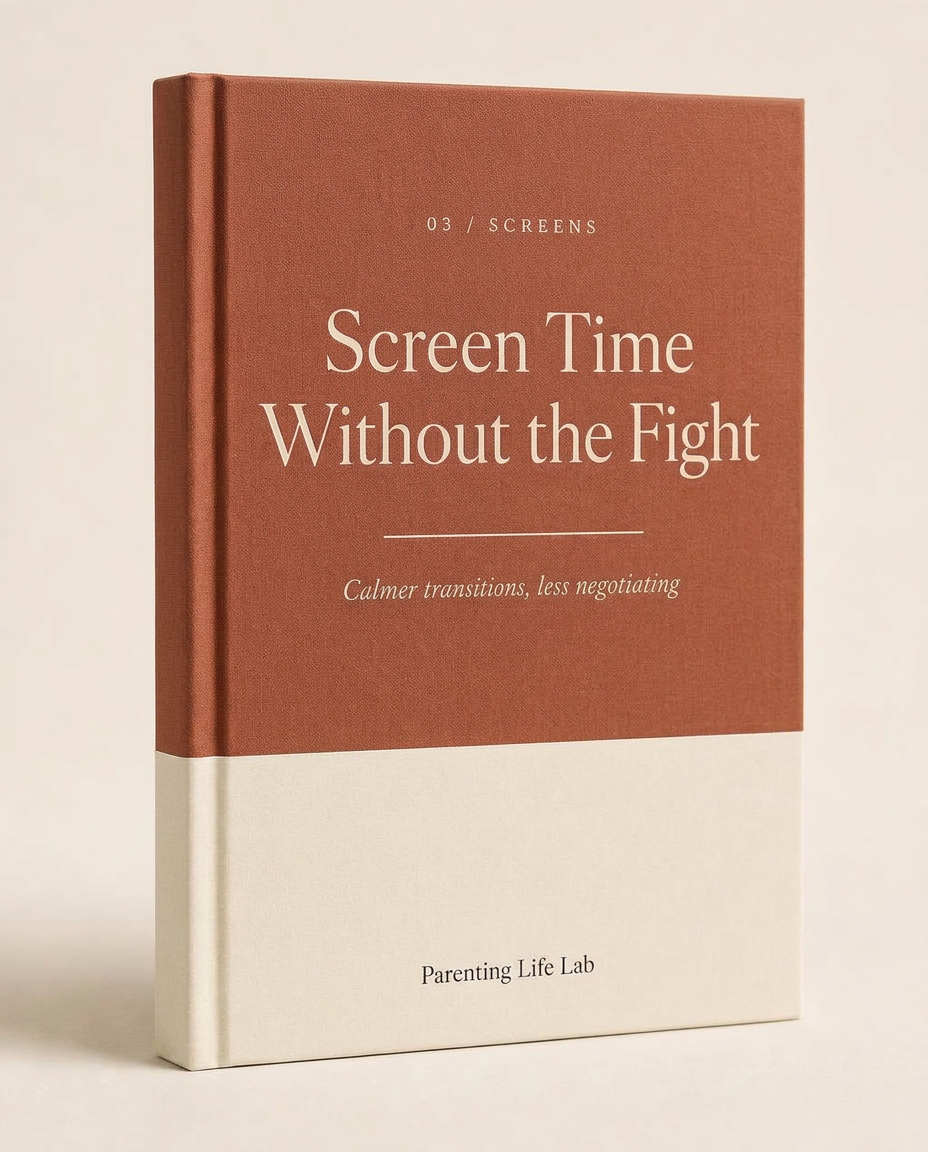
Screen Time Without the Fight
Nobody argues about the screen. They argue about the ending.
Calmer transitions. Clearer boundaries. Less daily negotiating.
Instant PDF download · Secure checkout · Keep it forever
- 80 pages
- Instant download
- Written by K P S Moeller
- Personal support
One evening of reading and writing, and you finish with your own plan on paper — not another article to remember.
Free advice gives you a screen-time limit. This gives you the ending routine, the one-page family plan and the scripts for the five arguments you already know are coming.
Write the ending routine and the one-page plan for the two devices that cause the most conflict. That covers most evenings, and you never have to finish all 80 pages.
Taking more than one? Any 2 guides save 15 percent, and the full library saves 25.
Sold by LouLouEntertainment, Stockholm. Payment handled by Stripe, download delivered instantly and emailed to you. Questions answered personally at hello@parentinglifelab.com.
When you finish the Core pass, you'll have this written down
- A one-page family screen plan covering when, where and what
- An ending routine for the last two minutes of screen time
- Warnings and countdowns that fit what your child is watching
- Answers ready for the five arguments you get every week
- Your 7-day test, with space to record where it broke
How it is used
- 1Core60–90 minutesRead it in one evening and fill in your own plan as you go.
- 27-day testOne weekRun the plan for a week. One small change per day, nothing rebuilt overnight.
- 3Deep DiveWhen it breaksCome back to the section for the situation that went wrong, and adjust.
80 pages in total, Core first and Deep Dive after.
The mechanism, step by step
01Split the problem
You separate the content, the amount and the transition, because those three need different fixes.
02Design the ending first
You write how screens end, since the last two minutes decide how the whole evening feels.
03Write the family plan
One page covering when, where, what and what happens when the answer is no.
04Move enforcement to the plan
The boundary stops depending on which adult is home and starts belonging to the agreement.
05Script the arguments
You prepare answers to the five arguments that already come up, including the everyone-else-is-allowed one.
06Test for 7 days
A week of running the plan and recording where it broke rather than whether it worked.
You can write the plan alone and still get most of the benefit, since the point is that the plan holds the boundary instead of a person.
If you only have 20 minutes
Write the ending routine and the one-page plan for the two devices that cause the most conflict. That covers most evenings, and you never have to finish all 80 pages.
Nobody argues about the screen. They argue about the ending. The last five minutes that turn into fifteen, the one more episode, the console that gets switched off mid-round and the twenty minutes of fallout that follows.
Most families do not need stricter rules. They need rules that stay the same on Tuesday when everyone is tired.
The goal is not zero screens. It is fewer battles about them.
This is not a screen-free challenge
There is no universal number of minutes in this workbook, and no argument that screens are ruining your child. Both of those conversations are loud and neither one helps at half past five on a Wednesday.
What helps is a plan the whole family understands, that the tired parent can follow, and that can be adjusted without starting from zero.
The best screen plan is not the strictest one. It is the one that survives an ordinary bad week.
What is inside the workbook
10 short parts across Core and Deep Dive, written to be used rather than read once.
- 01
What is actually going wrong
Separating the content, the amount and the transition, because those three need different fixes.
- 02
Endings first
Why the last two minutes decide how the whole day feels, and how to make them predictable.
- 03
The family screen plan
A one-page agreement covering when, where, what and what happens when the answer is no.
- 04
Warnings that work
The difference between a countdown that helps and one that starts the argument early.
- 05
When one parent is always the enforcer
How to move from one adult holding the boundary to the plan holding it.
- 06
Different ages, same house
Handling siblings with genuinely different needs without the younger one policing the older one.
- 07
Negotiation scripts
What to say to the five most common arguments, including the one about everyone else being allowed.
- 08
Repair after a bad evening
How to reset without cancelling screens for a week in a moment of frustration.
- 09
The 7-day test
Run the plan for a week and record where it broke rather than whether it worked.
- 10
Low-energy mode
What the plan shrinks to during illness, travel and the weeks nobody has capacity.
A look inside
3 of 80 pages shown at full size. Nothing here is a mock-up — these are the pages you print.
This is for you if
- Screen endings create the same conflict most days
- The rules change depending on which adult is home
- One parent has become the permanent enforcer
- Screens are useful in your family but cost too much emotional energy to manage
Probably not for you if
- You want one universal number of minutes per age
- You want an argument that screens are always harmful
- Screen use is tied to a serious safety issue such as exploitation or self-harm. That needs professional support first.
What this is built on
This workbook is not original research. It is a practical translation of work by people who did the research, tested against one ordinary family over several months. Here is what was read while writing it, and what each book actually contributed.
The Art of Screen Time — Anya Kamenetz
Why the amount of screen time matters less than what surrounds it, which is the whole premise of the workbook.
Glow Kids — Nicholas Kardaras
Read as the counter-argument. The workbook keeps the caution about transitions and drops the alarmism.
How to Talk So Kids Will Listen & Listen So Kids Will Talk — Adele Faber & Elaine Mazlish
The language used for ending a session without a negotiation each time.
Book links go to Amazon and may earn a small commission at no cost to you. The full reading list behind the site is on the sources page, and the writing process is described in the methodology.
Edition 1.0 · updated August 1, 2026
- v1.0 (August 1, 2026) — First public edition. Every future revision will be listed here with the date.
Buy once and every later edition of this workbook is yours. Updates are sent to the email address you ordered with.
Questions people ask before buying
- What exactly do I get?
- A 80-page interactive PDF workbook, formatted for US Letter. Core is the first pass, Deep Dive is the troubleshooting library. Print it or fill it in digitally in any PDF reader that supports annotation.
- How is it delivered?
- Instantly. After checkout you land on a download page, and the same link is emailed to you so you can come back to it later.
- How long does it take?
- Core takes about 60 to 90 minutes, followed by a 7-day test in normal family life. Deep Dive is meant to be read in pieces, when a specific situation comes up.
- Can I get a refund?
- It is a digital file, so it cannot be returned once downloaded. If it is not what you expected, write to hello@parentinglifelab.com within 14 days and we will sort it out.
- Do I need to buy the other guides too?
- Screen Time Without the Fight is complete on its own. The guides share a language, so they stack well, which is why two or more come with a discount — and until 31 August the 15% welcome offer stacks on top. None of them assume you own another one.
- Is there a low-energy version?
- Yes. Every guide has a low-energy mode: the smallest version of the system that still works during illness, deadlines, travel and the weeks you have nothing left.
Instant PDF workbook, Core + Deep Dive download, 80 pages. One-time payment in USD, no subscription. Written by K P S Moeller, the publishing byline of Per Moller, founder of Parenting Life Lab and sole proprietor of LouLouEntertainment (Sweden). Payments are processed securely by Stripe, with tax calculated at checkout.
By completing checkout you ask for the file to be delivered immediately and agree that your 14-day right of withdrawal ends once the download is delivered. All sales are final after that point, apart from the delivery problems listed in the refund policy.
Often taken together
These three normally cost $20.70. Together they are $17.59, because of the bundle discount of 15 percent.
Build your own bundle
Calmer transitions. Clearer boundaries. Less daily negotiating.
80 pages, $6.90, and about ninety minutes of reading before anything in your week has to change.
Listen while you think it over
Want to go deeper first?
Audible has a free trial with thousands of parenting and psychology titles. If you are not ready for the workbook yet, this is a low-pressure way to keep learning.
Try Audible freeAffiliate link. As an Amazon Associate we earn from qualifying purchases, at no extra cost to you. Full disclosure.

Atomic Habits for Families: Building Small Routines That Stick
How James Clear's powerful habit-building principles can transform chaotic mornings into smooth, predictable family routines—one tiny change at a time.

No-Drama Discipline: Creating Calm Routines That Actually Work
Transform daily discipline battles into real teaching moments using the connect-and-redirect approach that builds lasting cooperation and self-regulation.

Creating Meaningful Family Moments Through Intentionality
Chip and Dan Heath's research reveals how small, intentional moments create lasting childhood memories and strengthen family bonds—no elaborate planning needed.
$6.90
80 pages · instant download