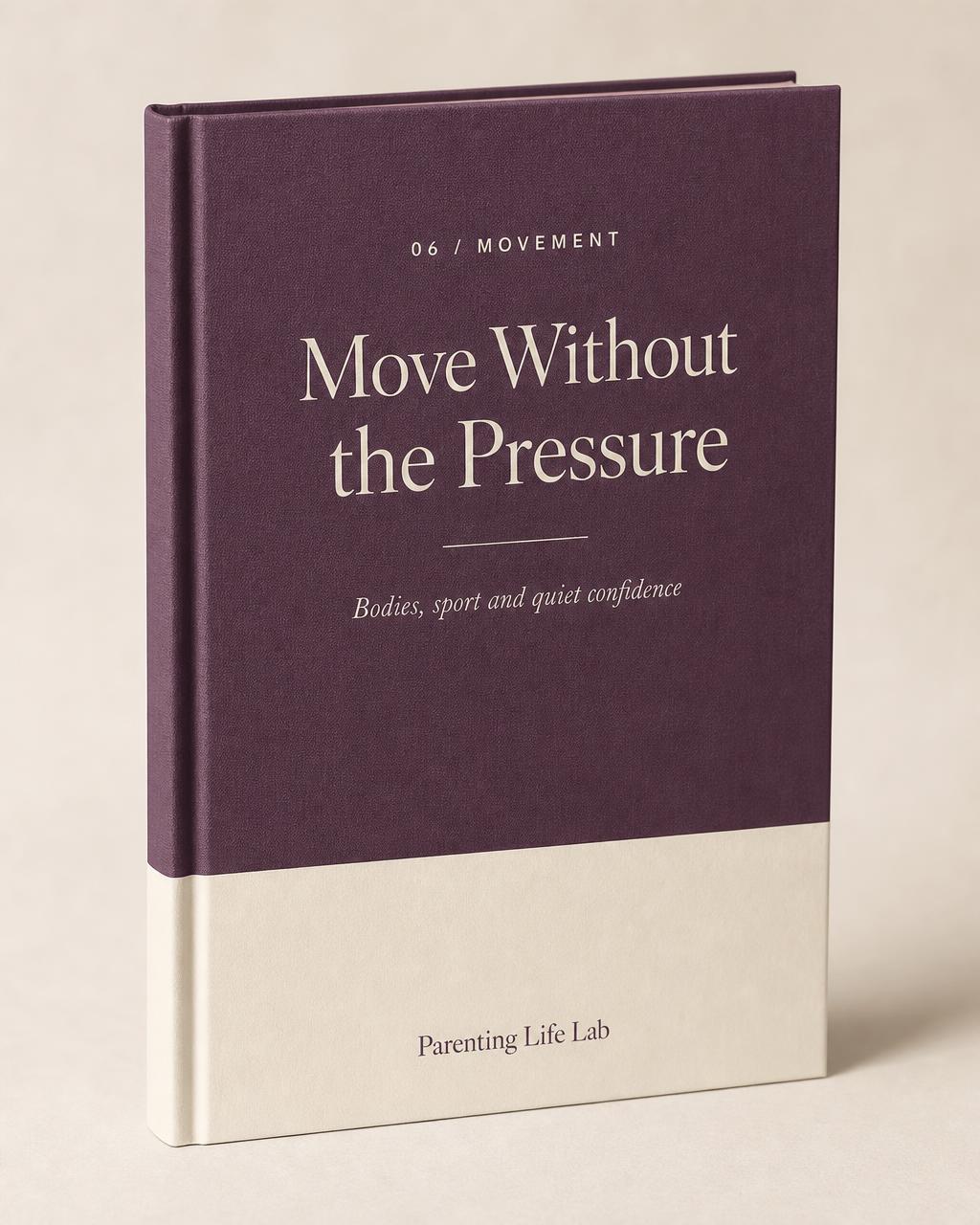
Move Without the Pressure
You want them to enjoy moving. Somehow it turned into pressure.
Help movement grow without turning it into another battle.
Instant PDF download · Secure checkout · Keep it forever
- 103 pages
- Instant download
- Written by K P S Moeller
- Personal support
One evening of reading and writing, and you finish with your own plan on paper — not another article to remember.
Free advice says be supportive, not pushy. This shows you the exact sentences that cross the line, and gives you a decision framework for the day they want to quit.
Name your role, write your three car-ride-home sentences and pick one comment to stop making. That is the change most families feel first, and you never have to finish all 103 pages.
Taking more than one? Any 2 guides save 15 percent, and the full library saves 25.
Sold by LouLouEntertainment, Stockholm. Payment handled by Stripe, download delivered instantly and emailed to you. Questions answered personally at hello@parentinglifelab.com.
When you finish the Core pass, you'll have this written down
- Clarity on the role you are playing around sport and movement
- Encouragement that does not turn into evaluation
- A plan for the car ride home
- A decision framework for when they want to quit
- Your 7-day experiment with the pressure turned down
How it is used
- 1Core60–90 minutesRead it in one evening and fill in your own plan as you go.
- 27-day testOne weekRun the plan for a week. One small change per day, nothing rebuilt overnight.
- 3Deep DiveWhen it breaksCome back to the section for the situation that went wrong, and adjust.
103 pages in total, Core first and Deep Dive after.
The mechanism, step by step
01Name your role
You write down which role you are actually playing: supporter, manager, coach or audience.
02Separate encouragement from evaluation
You mark which of your usual comments build and which quietly grade a child.
03Plan the car ride home
You decide in advance what gets said and what gets left alone in the first ten minutes after any performance.
04Look for fit
You map which kinds of movement suit this child body, temperament and social needs, instead of the sport you happened to start with.
05Use the quitting framework
A bad month, a bad coach, a bad fit and a real ending get separated before any decision is made.
06Run a 7-day experiment
One week of changed parent behaviour, with a place to record what the child did differently.
This one works entirely alone. It changes what the adult does, so you do not need the other parent, the coach or the child to agree to anything first.
If you only have 20 minutes
Name your role, write your three car-ride-home sentences and pick one comment to stop making. That is the change most families feel first, and you never have to finish all 103 pages.
The car ride home is where most of it goes wrong. Not the match, not the training, the eleven minutes afterwards when a well-meant question lands as a review.
You cannot manufacture enthusiasm for movement. You can make it easier to access, lower the pressure around it, and help a child notice what actually fits them.
This workbook is about the parent role around movement and sport, not about producing an athlete.
This is not a training plan
There are no age-specific minutes here, no training volumes, no performance targets and no body-composition talk. Those belong with health professionals and coaches, not with a parent workbook.
When movement matters to adults, the temptation is to push harder. A long-term positive relationship with movement is easier to protect when taking part is not proof of worth, obedience or discipline.
The measure of success is whether a child can carry movement forward, not whether they got better this season.
What is inside the workbook
10 short parts across Core and Deep Dive, written to be used rather than read once.
- 01
What role are you playing
Supporter, manager, coach or audience, and what each one costs when it is the wrong one.
- 02
Useful encouragement
The specific difference between comments that build and comments that quietly become evaluation.
- 03
The car ride home
What to say and what to leave alone in the first ten minutes after any performance.
- 04
Finding the fit
Helping a child notice which kinds of movement suit their body, temperament and social needs.
- 05
When they want to quit
A decision framework separating a bad month, a bad coach, a bad fit and a real ending.
- 06
Competition days
Preparing, being present and handling losses without a debrief nobody asked for.
- 07
Coach and club challenges
When to raise something, how to raise it and when to leave.
- 08
Access, cost and logistics
Realistic options when money, transport, time or two homes limit what is possible.
- 09
Bodies and belonging
Keeping the conversation away from shape and weight while still talking honestly about health.
- 10
The 7-day experiment
One week of changed parent behaviour, with a place to record what the child did differently.
A look inside
3 of 103 pages shown at full size. Nothing here is a mock-up — these are the pages you print.
This is for you if
- Sport has started to feel like pressure for both of you
- A child wants to quit and you cannot tell whether to let them
- You want to encourage movement without becoming a commentator
- Competition days end badly more often than they end well
Probably not for you if
- You want a training or conditioning program
- You want help making a reluctant child more competitive
- You need clinical guidance about eating, injury or growth. That needs a professional.
What this is built on
This workbook is not original research. It is a practical translation of work by people who did the research, tested against one ordinary family over several months. Here is what was read while writing it, and what each book actually contributed.
The Whole-Brain Child — Daniel J. Siegel & Tina Payne Bryson
Naming a feeling to take the edge off it, which is why the workbook lets a child grieve the old home instead of selling the new one.
Third Culture Kids — David C. Pollock, Ruth E. Van Reken & Michael V. Pollock
What unresolved goodbyes cost later, and why closure matters more than excitement about the destination.
The Gardener and the Carpenter — Alison Gopnik
Why keeping a few routines identical gives a child something stable when everything else has changed.
Book links go to Amazon and may earn a small commission at no cost to you. The full reading list behind the site is on the sources page, and the writing process is described in the methodology.
Edition 1.0 · updated August 1, 2026
- v1.0 (August 1, 2026) — First public edition. Every future revision will be listed here with the date.
Buy once and every later edition of this workbook is yours. Updates are sent to the email address you ordered with.
Questions people ask before buying
- What exactly do I get?
- A 103-page interactive PDF workbook, formatted for US Letter. Core is the first pass, Deep Dive is the troubleshooting library. Print it or fill it in digitally in any PDF reader that supports annotation.
- How is it delivered?
- Instantly. After checkout you land on a download page, and the same link is emailed to you so you can come back to it later.
- How long does it take?
- Core takes about 60 to 90 minutes, followed by a 7-day test in normal family life. Deep Dive is meant to be read in pieces, when a specific situation comes up.
- Can I get a refund?
- It is a digital file, so it cannot be returned once downloaded. If it is not what you expected, write to hello@parentinglifelab.com within 14 days and we will sort it out.
- Do I need to buy the other guides too?
- Move Without the Pressure is complete on its own. The guides share a language, so they stack well, which is why two or more come with a discount — and until 31 August the 15% welcome offer stacks on top. None of them assume you own another one.
- Is there a low-energy version?
- Yes. Every guide has a low-energy mode: the smallest version of the system that still works during illness, deadlines, travel and the weeks you have nothing left.
Instant PDF workbook, Core + Deep Dive download, 103 pages. One-time payment in USD, no subscription. Written by K P S Moeller, the publishing byline of Per Moller, founder of Parenting Life Lab and sole proprietor of LouLouEntertainment (Sweden). Payments are processed securely by Stripe, with tax calculated at checkout.
By completing checkout you ask for the file to be delivered immediately and agree that your 14-day right of withdrawal ends once the download is delivered. All sales are final after that point, apart from the delivery problems listed in the refund policy.
Often taken together
These three normally cost $20.70. Together they are $17.59, because of the bundle discount of 15 percent.
Build your own bundle

Help movement grow without turning it into another battle.
103 pages, $6.90, and about ninety minutes of reading before anything in your week has to change.
Listen while you think it over
Want to go deeper first?
Audible has a free trial with thousands of parenting and psychology titles. If you are not ready for the workbook yet, this is a low-pressure way to keep learning.
Try Audible freeAffiliate link. As an Amazon Associate we earn from qualifying purchases, at no extra cost to you. Full disclosure.

Teaching Kids Extreme Ownership: Lessons from Jocko Willink
Jocko Willink's extreme ownership teaches children to take responsibility for their outcomes, building real confidence through discipline and accountability.

The Whole-Brain Child: Building Resilience Through Brain Science
Understanding your child's developing brain transforms tantrums into teaching moments and builds lasting emotional resilience, one connection at a time.

Growth Mindset for Kids: How We Talk About Success Matters
Carol Dweck's groundbreaking research reveals how praising effort over talent creates resilient children who embrace challenges and learn from failure.
$6.90
103 pages · instant download